


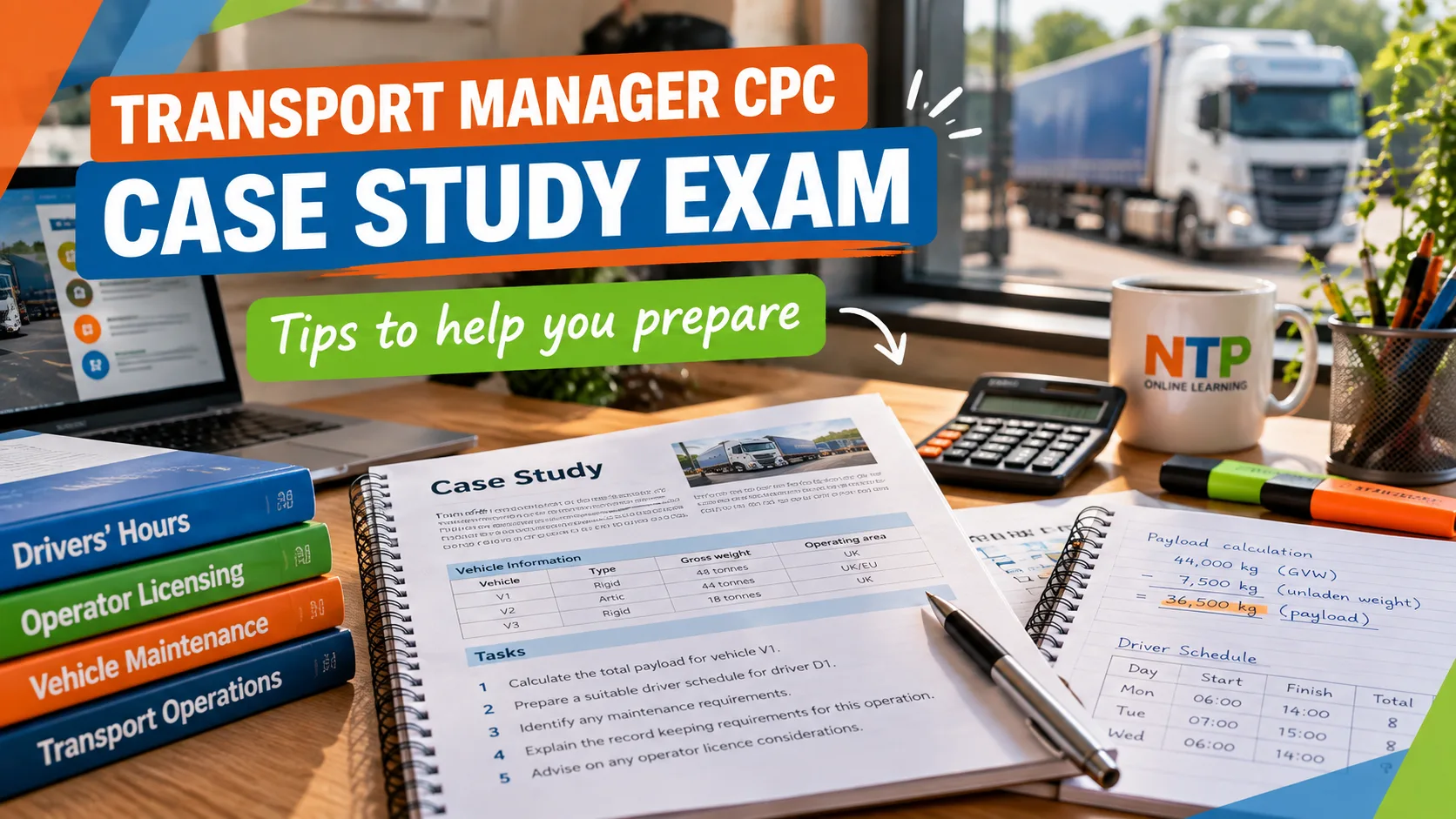
Transport Manager CPC Case Study Exam: What to Expect and How to Prepare
If you’re studying for your CILT(UK) Transport Manager CPC, the Case Study exam is likely to be the part you’re most unsure about.
What will the case study look like? What sort of questions will you be asked? How much do you need to write? What should you revise? And, importantly, how can you prepare for it properly?
The Transport Manager CPC Case Study isn’t simply a test of how many facts you can remember. It’s about whether you can take what you’ve learned and apply it to realistic transport situations.
That’s why knowing the syllabus is only part of your preparation.
You also need to practise using that knowledge.
In this guide, we’ll explain how the Transport Manager CPC Case Study exam works, what you should expect and our practical tips for preparing for exam day.
What Is the Transport Manager CPC Case Study Exam?
The Case Study is one of the two assessments you need to pass to achieve the CILT(UK) Transport Manager CPC qualification.
The two assessments are:
- Paper 1 – Multiple-Choice
- Paper 2 – Case Study
You need to pass both assessments to achieve the full qualification.
The big difference between them is how your knowledge is tested.
The multiple-choice assessment tests your understanding across the syllabus by asking you to select answers.
The Case Study exam asks you to apply your knowledge to a transport operation and work through practical problems and situations.
This is why some learners who know the course material really well can still find the Case Study challenging.
Knowing something and applying it correctly under exam conditions are two different skills.
What Happens in a Transport Manager CPC Case Study?
You’re given information about a fictional transport operation or business scenario.
The scenario may contain information about areas such as:
- Vehicles
- Drivers
- Journeys
- Operating arrangements
- Costs
- Maintenance
- Working patterns
- Compliance
- Operator licensing
- Drivers’ hours
- Vehicle weights and dimensions
You then answer questions using the information you’ve been given alongside the knowledge you’ve gained during your Transport Manager CPC studies.
The important word here is apply.
You’re not simply being asked:
“What do you know about this subject?”
You’re being asked:
“Can you use what you know to deal with this particular situation?”
That’s a very different way of thinking.
Why Is the Transport Manager CPC Case Study Important?
Think about what a Transport Manager actually does.
In the real world, somebody isn’t going to walk into the transport office and ask you to recite a section of legislation.
Instead, you’ll be dealing with situations.
A driver may have a problem with their hours.
A vehicle may need to be scheduled for maintenance.
A journey needs planning.
A cost needs calculating.
An issue develops with an operator licence.
Something happens that could affect compliance.
You need to look at the information available, understand the relevant rules and decide what needs to happen.
The Case Study assessment is designed around this ability to apply transport management knowledge to practical situations.
What Topics Could Appear in the Transport Manager CPC Case Study?
Your preparation should cover the full syllabus rather than trying to predict a handful of questions.
Areas you should be comfortable applying include:
- Operator licensing
- Drivers’ hours
- Working Time rules
- Driver licensing
- Driver scheduling
- Vehicle maintenance and safety inspections
- Vehicle weights and dimensions
- Safe loading
- Vehicle costing
- Financial calculations
- Route and journey planning
- Speed limits
- Road safety
- Record keeping
- International operations where relevant
- Workplace and employment matters
- Transport documentation and compliance
One of the biggest mistakes you can make is revising only the subjects you hope will appear.
The scenario can require you to bring together knowledge from several different parts of the course.
Transport Manager CPC Case Study Calculations
Don’t ignore calculations when preparing for your Case Study.
They can be an important part of applying your knowledge.
Depending on the question and syllabus, you could need to work with areas such as:
- Vehicle operating costs
- Standing and running costs
- Journey times
- Driver schedules
- Payloads
- Vehicle weights
- Fuel costs
- Financial information
The best way to improve at calculations isn’t to read somebody else’s worked answer repeatedly.
Do the calculation yourself.
Then check your answer.
If you’ve got it wrong, don’t just look at the correct figure and move on.
Work out why you got it wrong.
Was it the formula?
Did you use the wrong figure from the scenario?
Did you misunderstand what the question was asking?
Was it simply a calculator error?
Finding the reason is much more useful than memorising the answer.
Our Tips for the Transport Manager CPC Case Study Exam
1. Read the Scenario Properly
It can be tempting to rush through the scenario because you want to get started on the questions.
Don’t.
The information is there for a reason.
Look carefully at the vehicles, drivers, times, journeys, costs, maintenance arrangements and other details you’re given.
Ask yourself:
Why have I been given this information?
A small detail that doesn’t initially look important could become very relevant when you reach a question.
2. Answer the Question You’ve Actually Been Asked
This sounds obvious, but it’s one of the easiest things to get wrong under pressure.
Imagine you’ve spent hours revising drivers’ hours.
A drivers’ hours question appears.
You recognise the subject and immediately want to write down everything you know.
But is that what the question asked you to do?
Pay attention to words such as:
- Identify
- State
- Explain
- Calculate
- Outline
- Prepare
- Evaluate
If you’re asked to identify something, the answer required may be very different from a question asking you to explain it.
Don’t try to impress the examiner with everything you know.
Give them what the question asks for.
3. Look at the Marks Available
The marks can give you a useful indication of how much the question expects from you.
A question worth only a small number of marks probably doesn’t need an enormous essay.
Equally, a higher-mark question may need several separate points, calculations or pieces of information.
Use the available marks to help you judge the level of detail required.
4. Don’t Spend Too Long on One Question
Time management matters.
It’s easy to get stuck on one calculation or question and become determined to solve it.
Before you know it, you’ve used a large amount of your exam time.
If you’re genuinely stuck, consider moving on and returning to it later.
There may be marks elsewhere on the paper that you can pick up much more easily.
Your job is to collect marks across the assessment.
5. Practise Driver Scheduling
Driver scheduling brings several areas of your knowledge together.
You may need to think about driving time, breaks, rest periods, working time and the practical requirements of the journey.
Don’t only learn the rules individually.
Practise applying them to realistic schedules.
That’s where you’ll discover whether you really understand them.
6. Understand Maintenance Planning
As a future Transport Manager, you need to understand how an effective vehicle maintenance system works.
Don’t just memorise phrases.
Make sure you understand why maintenance systems, safety inspections, defect reporting and appropriate records matter to a compliant operation.
When faced with a case study, you then have a much better chance of recognising what needs to happen.
7. Show Your Working on Calculations
Don’t make your calculation process unnecessarily difficult to follow.
Work through the information logically and carefully.
Showing a clear calculation can also help you spot mistakes before moving on.
Check:
Have I used the right figures?
Have I used the correct units?
Does my final answer actually make sense?
That last check is important.
If your calculation says a journey will take 47 hours when you expected roughly four, something has probably gone wrong.
8. Don’t Make Assumptions the Scenario Doesn’t Give You
Read exactly what you’ve been told.
Under pressure, it’s easy to fill in missing information in your own head.
That can send you down completely the wrong path.
Base your answer on the facts provided in the scenario together with the relevant knowledge from your studies.
The Best Way to Revise for the CPC Case Study: Actually Do Case Studies
This is probably our biggest piece of advice.
You cannot properly prepare for a Case Study exam just by reading notes.
Reading and learning the Transport Manager CPC syllabus gives you the knowledge you need.
Case study practice teaches you how to use it.
It’s a bit like learning to drive.
You could read the Highway Code and a driving manual from cover to cover, but eventually you need to get behind the wheel.
The same principle applies here.
Complete case studies.
Make mistakes.
Check your answers.
Work out why you lost marks.
Then do another one.
If you need more papers to work through, NTP’s Transport Manager CPC Practice Case Studies for Road Haulage include 18 practice case studies with detailed answers.
Don’t Complete Case Studies With the Answers Beside You
This is an easy trap to fall into.
You read the question.
You’re not completely sure.
You have a quick look at the answer.
Suddenly everything makes sense.
The problem is that you’ve tested your ability to recognise an answer, not your ability to produce one yourself.
Try the question first without looking.
Even if you get it wrong, you’ve learned something useful.
You’ve identified an area that needs more work before exam day.
That’s exactly what practice is for.
Practise Under Timed Conditions
Once you’re comfortable completing case studies, start putting yourself under exam conditions.
Give yourself the appropriate amount of time and work through a fresh paper without constantly checking your course materials.
This can tell you a lot.
Are you reading questions quickly enough?
Are you spending too long on calculations?
Are you getting stuck on certain topics?
Are you rushing towards the end?
Do you know the information without constantly referring to your notes?
Practice should become more realistic as you get closer to the exam.
Use Different Case Studies
Don’t keep completing the same paper until you know all the answers.
You’ll get a fantastic score eventually – but it doesn’t necessarily mean you’re ready for the real assessment.
Use different scenarios and questions.
A new case study forces you to take the knowledge you’ve learned and apply it to something you haven’t seen before.
That’s much closer to what you’ll need to do in your CILT exam.
CILT provides official Transport Manager CPC sample papers, including Paper 2 sample assessments for Road Haulage and Passenger Transport. These are well worth using as part of your preparation.
For additional practice, NTP also provides Transport Manager CPC Practice Case Studies for Road Haulage, designed to give learners more experience working through realistic scenarios and exam-style questions.
Learn From the Questions You Get Wrong
Getting a question wrong during revision isn’t a bad thing.
It’s useful.
You’ve just found something you can improve before the real exam.
For every mistake, ask:
Did I not know the subject?
Did I know it but misunderstand the question?
Did I use the wrong information from the scenario?
Did I make a calculation error?
Did I know the answer but fail to explain it properly?
Those are different problems and they need different solutions.
Simply marking an answer wrong and moving to the next question wastes a valuable opportunity.
Knowing the Answer Isn’t Always Enough
This is particularly important with case studies.
You may understand a subject perfectly well but still lose marks because you haven’t answered the specific question clearly enough.
Practise turning what you know into clear, relevant answers.
Avoid padding an answer with information that isn’t needed just because you remember it.
Keep bringing yourself back to one question:
What exactly am I being asked?
What Should I Do If I Don’t Know an Answer?
Don’t panic.
Read the question again.
Look back at the scenario.
Break the question into smaller parts.
Think about which part of the Transport Manager CPC syllabus it relates to.
Sometimes you know more than you initially think, but the wording of the question has thrown you.
If you’re still completely stuck and spending too much time on it, move on.
Come back if you have time.
Don’t allow one difficult question to affect the rest of your assessment.
How Do I Know If I’m Ready for the Transport Manager CPC Case Study?
Don’t judge your readiness purely by the number of hours you’ve spent studying.
Test yourself.
Take a case study you haven’t completed before and ask:
- Can I understand what the scenario is telling me?
- Can I identify what each question actually wants?
- Can I apply drivers’ hours correctly?
- Can I work through a driver schedule?
- Can I deal with maintenance questions?
- Can I complete vehicle costing and other calculations?
- Can I find and use the relevant information from the scenario?
- Can I complete the assessment within the available time?
- Can I do this without constantly relying on my notes?
The more confidently you can answer yes, the better prepared you’re becoming.
Can I Get Extra Transport Manager CPC Case Study Practice?
Yes.
NTP Online Learning offers a dedicated Transport Manager CPC Practice Case Study bundle for Road Haulage, with 18 practice case studies and detailed answers.
They’re designed to be used as additional exam preparation alongside your Transport Manager CPC studies, rather than as a replacement for learning the full syllabus.
Working through a wider variety of scenarios can help you improve:
- Question interpretation
- Calculations
- Driver scheduling
- Applying legislation
- Problem solving
- Time management
- Exam technique
Most importantly, practice gives you the chance to get things wrong now, find out why and put them right before the real exam.
What If I’ve Already Failed the Transport Manager CPC Case Study?
First, use the experience.
You’ve now seen the real assessment.
Think carefully about what caused you problems.
Was it knowledge?
Calculations?
Driver scheduling?
Maintenance?
Time management?
Understanding the questions?
Applying what you’d learned?
Your next revision plan should be built around those weaker areas rather than simply starting at page one of your course notes again.
NTP’s Transport Manager CPC Exam Resit Training is designed for learners who have already studied the qualification but need focused preparation before attempting one or both assessments again.
You can also read our guide: How to Pass Your Transport Manager CPC Case Study Resit.
Final Advice for Your Transport Manager CPC Case Study Exam
The Case Study exam can feel daunting because you don’t know exactly what scenario you’re going to face.
But that’s also why good preparation makes such a difference.
Don’t try to predict the exact questions.
Instead:
Learn the syllabus.
Understand the rules rather than simply memorising them.
Practise calculations.
Complete plenty of different case studies.
Learn from your mistakes.
Practise under timed conditions.
Read every question carefully.
And above all, practise applying your knowledge.
That’s what the Case Study is really testing.
The aim isn’t just to know what a Transport Manager should know.
It’s being able to use that knowledge when you’re given a real-world transport problem to solve.
Need More Help Preparing for Your Transport Manager CPC Exams?
NTP Online Learning provides Transport Manager CPC online training for Road Haulage, including course materials, knowledge tests, mock examinations, tutor-marked practice case studies and tutor support.
If you’re already studying and simply want additional Road Haulage Case Study practice, our 18 Transport Manager CPC Practice Case Studies give you extra scenarios and detailed answers to work through before your exam.
And if you’ve already attempted the assessment but haven’t passed, our Transport Manager CPC Exam Resit Training provides focused revision and tutor support to help you prepare for your next attempt.
The important thing is not simply doing more revision.
Make sure the revision you’re doing is preparing you for what the Case Study actually asks you to do.