


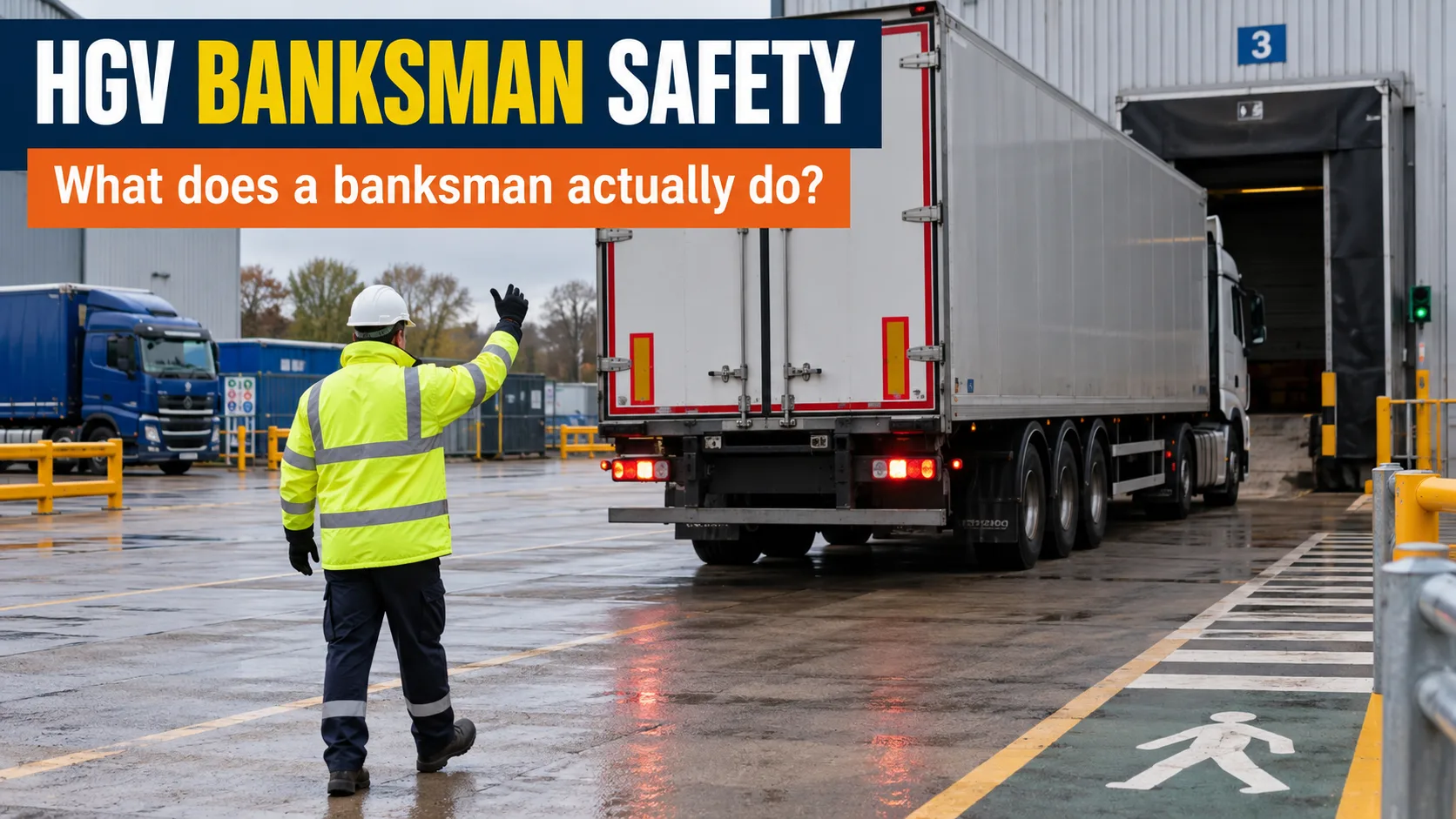
What Is a Banksman and What Do They Do?
A banksman is a trained person who helps direct vehicle movements safely on or around a workplace. Also commonly referred to as a traffic marshal, a banksman may be used to help drivers manoeuvre HGVs and other vehicles where risks cannot be adequately controlled in another way.
If you operate HGVs, vans or other commercial vehicles in a busy yard, depot, warehouse, construction site or loading area, vehicle movements can present a serious risk to pedestrians and other workers.
But when is a banksman actually needed? What do they do? Where should they stand? And what should an HGV driver do if they lose sight of them?
In this guide, we answer some of the most common questions about banksmen, HGV reversing and workplace vehicle safety.
Banksman at a Glance
What is a banksman?
A trained person who helps direct vehicle movements safely on or around a workplace.
What is another name for a banksman?
Banksmen are also commonly referred to as traffic marshals.
When might a banksman be used?
Where vehicle manoeuvring risks cannot be adequately controlled through safer alternatives.
Does a banksman need training?
Yes. A banksman directing reversing vehicles should be trained, competent and authorised.
What happens if a driver loses sight of the banksman?
The driver should stop immediately.
Does every reversing HGV need a banksman?
No. Avoiding or reducing reversing should be considered before relying on a banksman.
What Is a Banksman?
A banksman is a trained person who helps direct vehicle movements on or around a workplace.
According to the Health and Safety Executive (HSE), banksmen can be used to direct vehicle movements, particularly where reversing cannot be avoided.
However, they should be properly trained and authorised. Businesses should also first consider whether risks can be controlled through other measures, such as separating pedestrians and vehicles or eliminating unnecessary reversing.
In simple terms, a banksman can act as an extra pair of eyes for a driver when manoeuvring a large vehicle.
That can be particularly important with an HGV, where the driver’s view may be restricted by the size and design of the vehicle.
What Does a Banksman Do?
The role of a banksman is to help control vehicle movements safely.
Depending on the workplace and the site’s risk assessment, their duties may include:
- guiding vehicles during reversing or other difficult manoeuvres;
- using clear, agreed hand signals to communicate with the driver;
- positioning themselves where the driver can see them;
- helping to keep people away from the vehicle’s manoeuvring area;
- identifying hazards that may not be immediately visible to the driver;
- assisting drivers when entering or leaving restricted areas;
- helping visiting drivers understand site traffic arrangements; and
- stopping a manoeuvre if it becomes unsafe.
A banksman needs to remain alert throughout the manoeuvre.
This isn’t a job for somebody who’s half watching what’s happening whilst doing something else.
They need to concentrate on the vehicle, the driver, pedestrians and the surrounding environment.
Why Are Banksmen Used Around HGVs?
HGVs can have significant blind spots, and the driver’s field of vision can change as the vehicle manoeuvres.
Large vehicles may also require considerable space to turn and manoeuvre. Articulated vehicles can be particularly challenging because the trailer follows a different path from the tractor unit.
This creates additional risks in busy yards where HGVs may be operating alongside:
- pedestrians;
- forklift trucks;
- vans;
- cars;
- loading equipment;
- other HGVs;
- buildings and structures; and
- loading bays.
HSE workplace transport guidance states that, as far as possible, workplaces should be designed so vehicles do not need to reverse.
Measures such as one-way systems and drive-through loading and unloading areas can help reduce reversing movements.
Where reversing cannot be avoided, additional controls may be required.
That’s where a properly trained banksman may form part of a safe system of work.
Related reading: What Is Vehicle Safety?
Should You Always Use a Banksman When Reversing an HGV?
No. A banksman is not automatically required every time an HGV reverses.
This is an important point.
HSE guidance says the need for reversing should be eliminated wherever possible. Where this cannot be achieved, reversing should be minimised and properly controlled.
HSE guidance also explains that banksmen should only be used where there is no other adequate way to control the reversing risks.
This is because putting another person close to a moving vehicle can itself introduce additional risk.
Before relying on a banksman, operators and site managers should therefore consider controls such as:
- separating vehicles and pedestrians;
- one-way traffic systems;
- drive-through loading areas;
- clearly marked vehicle routes;
- designated reversing areas;
- barriers and pedestrian walkways;
- mirrors and CCTV;
- appropriate lighting;
- reversing aids; and
- changing the layout of the site to reduce unnecessary manoeuvring.
In other words, don’t introduce a person into a dangerous area if you can remove or adequately control the danger another way.
What Happens If the Driver Cannot See the Banksman?
If the driver loses sight of the banksman, the driver should stop immediately.
This is one of the most important rules when a banksman is being used.
The HSE says banksmen need to remain visible to the driver and stand in a safe position where they can guide the vehicle without being in its path.
There should be no guessing.
The driver shouldn’t assume that the banksman has simply moved around the back of the vehicle or that it’s probably safe to carry on.
Can’t see the banksman? Stop.
The driver and banksman should understand this rule before the manoeuvre begins.
What Hand Signals Does a Banksman Use?
A banksman should use a clear and agreed system of signalling that the driver understands.
HSE guidance refers to standard hand signals under the Health and Safety (Safety Signs and Signals) Regulations 1996.
Before the vehicle starts moving, the driver and banksman should understand which signals are being used and what each signal means.
These can cover instructions such as:
- start;
- stop;
- move forwards;
- move backwards;
- move left;
- move right; and
- danger or emergency stop.
Good communication between the driver and banksman is essential.
Portable radios or other communication systems can sometimes help, but they should form part of the overall safe system rather than becoming an excuse for the banksman to stand somewhere the driver cannot see them.
Does a Banksman Need Training?
Yes. A banksman directing vehicle movements needs to be trained and competent.
HSE guidance says banksmen used for reversing should be trained and authorised.
Training should ensure that the person understands:
- their role and responsibilities;
- the site’s traffic management arrangements;
- the risks created by moving and reversing vehicles;
- vehicle blind spots;
- safe positioning;
- standard hand signals;
- communication with drivers;
- pedestrian management;
- what to do if communication is lost;
- when to stop a manoeuvre; and
- how to avoid putting themselves in the vehicle’s path.
Training shouldn’t simply be a box-ticking exercise.
The important question is whether the individual can competently and safely perform their role in the real working environment.
Need Banksman Awareness Training?
NTP Online Learning’s Banksman Awareness & Vehicle Safety at Work online course is designed to help people involved in workplace vehicle movements understand the role of a banksman, vehicle movement risks and safer working practices.
The online training can be used to support and supplement the practical training required for people undertaking banksman or traffic marshal duties.
Find out more: Banksman Awareness & Vehicle Safety at Work
Where Should a Banksman Stand?
A banksman should position themselves so that they are:
- visible to the driver;
- able to see the manoeuvring area; and
- safely away from the vehicle’s path.
They should never put themselves between a moving vehicle and a fixed object where they could become trapped or crushed.
Visibility is also important.
HSE guidance recommends high-visibility equipment and notes that some workplaces use distinctive high-visibility clothing to make the banksman easier for drivers to identify.
Suitable lighting should also be provided where vehicles are manoeuvring in poor or low-light conditions.
Banksman vs Signaller – What’s the Difference?
The terms are sometimes used interchangeably, but the HSE makes a distinction.
A banksman is trained to direct vehicle movements on or around a site.
A signaller, in the HSE construction context, is an operative trained to direct crane drivers during lifting operations.
Understanding the difference matters because the hazards, responsibilities and training requirements can be different.
Are Banksmen Only Used on Construction Sites?
No. Banksmen are not only used on construction sites.
Although banksmen are commonly associated with construction, vehicle manoeuvring risks exist in many workplaces.
You might see banksmen or traffic marshals working in:
- haulage yards;
- transport depots;
- warehouses;
- distribution centres;
- loading bays;
- factories;
- waste and recycling sites;
- construction sites;
- delivery areas; and
- other workplaces where large vehicles and pedestrians interact.
The exact control measures required should be based on the risks presented by the individual site and operation.
Why Is Vehicle and Pedestrian Segregation So Important?
One of the most effective ways to control workplace transport risk is to keep pedestrians and vehicles apart wherever reasonably practicable.
HSE guidance repeatedly emphasises segregation and reducing or eliminating reversing rather than relying solely on somebody standing behind a vehicle and directing it.
Businesses should therefore consider whether they have:
- clearly defined vehicle routes;
- dedicated pedestrian walkways;
- physical barriers where appropriate;
- safe crossing points;
- sensible speed limits;
- suitable signage;
- adequate lighting;
- controlled loading and unloading areas; and
- safe arrangements for visiting drivers.
A banksman can be an important control measure, but they should form part of a proper workplace transport safety system.
What Responsibilities Do HGV Operators Have?
Vehicle safety doesn’t begin and end with the driver.
Operators need to manage the risks within their businesses and make sure vehicles, drivers and workplace procedures are suitable for the work being carried out.
Robust procedures should cover areas such as:
- vehicle movements;
- reversing;
- pedestrian safety;
- loading and unloading;
- driver training;
- site inductions;
- visiting drivers;
- load security; and
- reporting safety concerns.
DVSA guidance also makes clear that people involved in loading vehicles or managing transport operations have responsibilities for making sure loads are safely loaded, secured during transport and safely unloaded.
Related reading: What Is Safe Loading?
The Traffic Commissioners can also take regulatory action against an operator’s licence where appropriate systems or processes are not in place to transport loads safely and securely.
Proper training and safe systems of work therefore aren’t just bits of paperwork to stick in a folder and forget about.
They need to work in the real world.
Banksman Safety Checklist
If your risk assessment identifies that a banksman is required, ask:
- Is the banksman properly trained and authorised?
- Are the driver and banksman using an agreed signalling system?
- Can the driver see the banksman throughout the manoeuvre?
- Does the driver know to stop immediately if visual contact is lost?
- Is the banksman wearing suitable high-visibility clothing?
- Does the banksman have a safe place to stand?
- Are pedestrians excluded from the reversing area?
- Is there adequate lighting?
- Are vehicle routes and reversing areas clearly identified?
- Have you considered whether reversing could be eliminated altogether?
- Are visiting drivers given appropriate site instructions?
- Is the system regularly reviewed to make sure it is actually working?
If the answer to any of these questions is no, it may be time to review your workplace transport procedures.
Frequently Asked Questions About Banksmen
What is a banksman?
A banksman is a trained person who helps direct vehicle movements on or around a workplace. They are also commonly known as traffic marshals.
What does a banksman do?
A banksman can help guide vehicles during difficult manoeuvres, including reversing, using agreed hand signals while remaining visible to the driver and positioned safely.
Does every reversing HGV need a banksman?
No. HSE guidance prioritises avoiding or minimising reversing and separating pedestrians from vehicles. A banksman may be considered where other measures cannot adequately control the reversing risk.
Does a banksman need training?
Yes. A banksman used to direct reversing vehicles should be trained, competent and authorised for the role.
What should a driver do if they lose sight of the banksman?
Stop immediately. The manoeuvre should not continue when the driver cannot see the banksman.
Is a banksman the same as a traffic marshal?
The terms are commonly used to describe people controlling or directing vehicle movements around a workplace.
Is a banksman the same as a signaller?
Not necessarily. HSE guidance distinguishes between a banksman directing workplace vehicle movements and a signaller trained to direct crane drivers during lifting operations.
Should a banksman wear high-visibility clothing?
Yes. They need to be easily identifiable and visible to the driver. Suitable high-visibility clothing and equipment can help achieve this.
Can radios be used between a banksman and driver?
Radios can sometimes help communication, but they should not replace appropriate positioning and visibility between the banksman and driver.
Does an HGV legally need a banksman when reversing?
There isn’t a blanket requirement for every reversing HGV to have a banksman. Appropriate controls should be determined through the workplace risk assessment, with avoiding and minimising reversing considered first.
Driver Training and Workplace Safety
Professional HGV driving is about far more than simply being able to drive a vehicle from A to B.
Drivers need to understand the risks they face in yards, depots, loading areas and customer sites, including reversing, pedestrians, vehicle blind spots, safe loading and unloading and load security.
To help operators provide continuous professional development for their drivers, NTP Online Learning has developed the Ultimate Professional Driver Programme.
The programme covers more than 20 topics designed to support professional HGV drivers and transport operators with practical knowledge that can help keep operations safe, legal and compliant.
You can also access NTP’s FREE training videos, which operators can use as additional training aids within their businesses.
Watch our Banksman Video for further practical information about the role.
Keep Your Drivers Confident, Competent and Compliant
Good workplace transport safety isn’t about waiting until there’s an accident and then changing the system.
It’s about identifying the risks beforehand, putting sensible controls in place and making sure everybody involved understands what they’re expected to do.
Whether it’s driver training, reversing procedures, load security, pedestrian segregation or the safe use of a banksman, training needs to translate into what actually happens out in the yard.
Speak to the NTP Online Learning team about keeping your transport operation and HGV drivers confident, competent and compliant.
Click the live chat widget to speak to our team. We’re here to help you put robust training programmes in place and keep your organisation safe, legal and on the road.
NTP Online Learning Ltd – Spalding, Lincolnshire, England | Serving the entire UK & Northern Ireland
Further Guidance
Health and Safety Executive (HSE): Workplace transport and banksman guidance
DVSA/GOV.UK: Load security guidance