


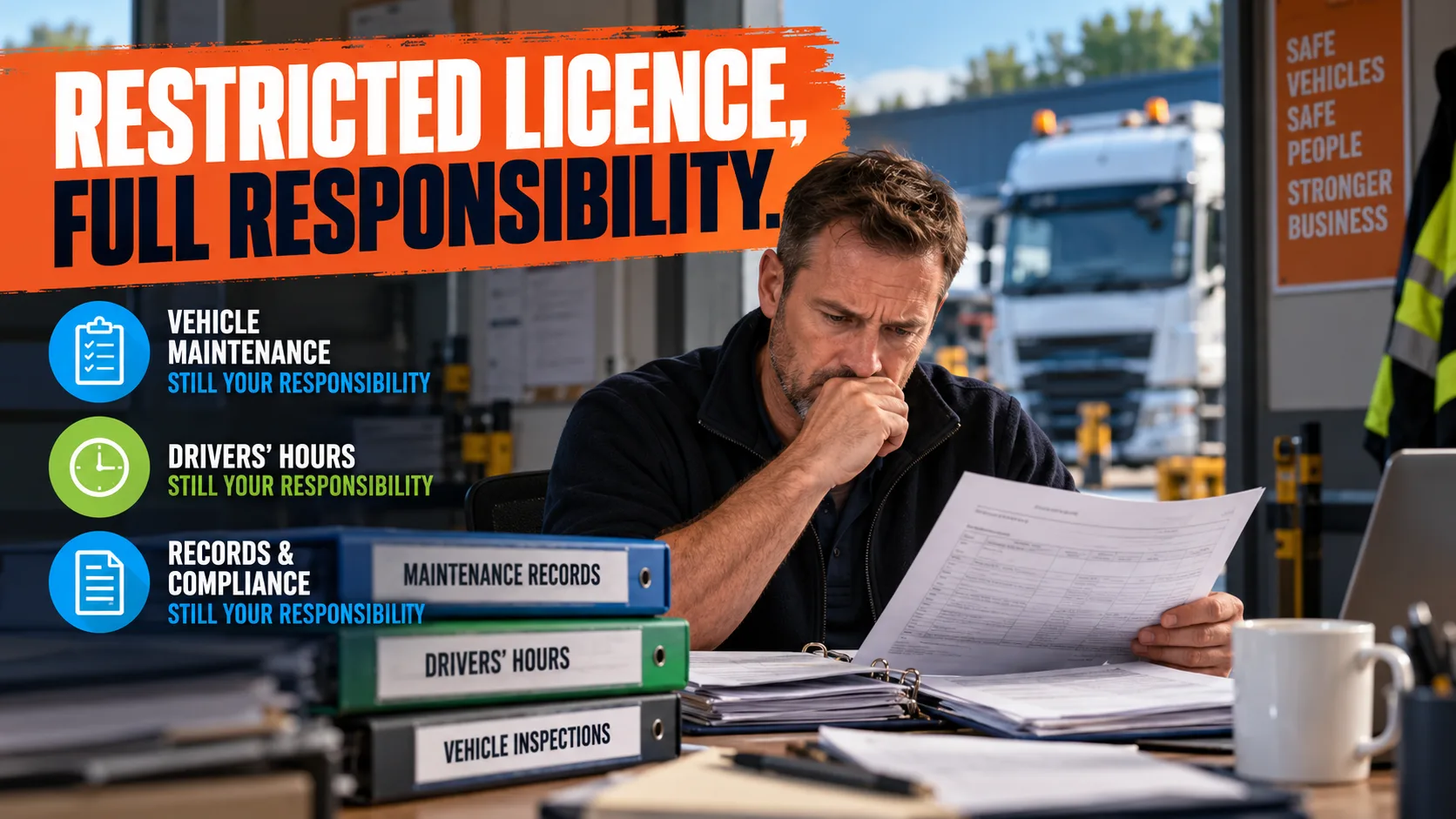
Restricted Operator Licence: Are You Taking on More Responsibility Than You Realise?
You don’t need a qualified Transport Manager. But that doesn’t mean you don’t need to understand the rules. And getting them wrong could put your business at risk.
You’ve got your Restricted Operator Licence.
You’ve got your vehicles, your drivers, your customers and a business to run.
Everything seems to be ticking along nicely.
But here’s a question that might make you feel a little uncomfortable.
If the DVSA walked into your business tomorrow and asked you to prove that your vehicles were being operated legally and safely, could you do it?
Not just tell them everything is fine.
Not just explain that your garage looks after the vehicles.
Actually produce the records, explain your systems and demonstrate that you understand your responsibilities.
Because if you can’t, you could have a much bigger problem than you realise.
And here’s the worrying part.
You might not even know you’re doing anything wrong.
1. The Biggest Misunderstanding About a Restricted Operator Licence
Let’s clear something up straight away.
A Restricted Operator Licence allows eligible businesses to operate goods vehicles for their own business purposes, subject to the restrictions of that licence.
Unlike a Standard Operator Licence, you are not required to appoint a professionally qualified Transport Manager holding a Transport Manager CPC.
Sounds straightforward, doesn’t it?
But here’s what some operators misunderstand.
Not needing a qualified Transport Manager does NOT mean you are exempt from transport legislation.
You still need to make sure your operation is properly managed.
You still need to understand the legal requirements.
And you still need to demonstrate that your vehicles are operated safely and compliantly.
The government’s own Goods Vehicle Operator Licensing Guide makes it clear that restricted licence holders must have sufficient knowledge to ensure compliance.
So, while you might not need to employ a qualified Transport Manager, someone still needs to understand and oversee the transport operation.
And if you’re the business owner, that responsibility ultimately sits with you as the operator.
2. Your Garage Maintains Your Vehicles. But Who Is Checking the Garage?
This is something we believe more restricted licence holders should be asking themselves.
You pay a garage to inspect and maintain your vehicles.
You trust them to do their job.
But what happens if they miss something?
What happens if an inspection is overdue?
What happens if a defect is reported but the vehicle continues operating?
You might think:
“Well, that’s the garage’s responsibility. I pay them to look after it.”
Unfortunately, it isn’t that simple.
Using an external maintenance provider does not remove your responsibility as the operator.
You should be able to demonstrate that you have effective systems for:
- Planned preventative maintenance inspections
- Daily vehicle walkaround checks
- Recording and rectifying defects
- Keeping maintenance records
- Monitoring vehicle roadworthiness
- Ensuring vehicles are not used when unsafe
And don’t forget, vehicle maintenance records generally need to be retained for at least 15 months.
Now ask yourself:
If an enforcement officer requested your last 15 months of maintenance records tomorrow, how quickly could you produce them?
If the answer is “I’d have to ring the garage and see what they’ve got”, it might be time to review your arrangements.
3. Your Driver Gets Stopped by the DVSA. Could It Lead Back to Your Business?
Imagine this.
It’s a Tuesday morning.
One of your drivers is heading out to a customer.
They get pulled into a DVSA roadside check.
An examiner identifies a serious vehicle defect.
Depending on the circumstances, the vehicle could be prohibited from continuing its journey until the necessary requirements have been met.
Your delivery is delayed.
Your customer isn’t happy.
Your driver is stuck.
But that might only be the beginning.
A roadside prohibition could also raise questions about your wider maintenance and compliance systems.
Were daily checks completed?
Was the defect reported?
Had the vehicle been inspected at the correct intervals?
Was the defect something your systems should have identified?
If concerns arise, they may lead to further investigation and potentially regulatory action.
In serious cases, an operator’s licence can be curtailed, suspended or revoked by the Traffic Commissioner.
Now imagine what losing the ability to operate your vehicles could mean for your business.
For some businesses, it could mean being unable to fulfil contracts or carry out essential work.
All because the systems behind the vehicles weren’t good enough.
4. Drivers’ Hours: Are You Sure Your Drivers Are Following the Rules?
Here’s another area where operators can find themselves in difficulty.
You employ experienced drivers.
They know their routes.
They know their vehicles.
And you trust them to manage their working day.
But do you know which drivers’ hours rules apply to your operation?
Do you understand when tachographs are required?
Are records being downloaded and analysed where necessary?
Are infringements being identified and addressed?
And are your drivers taking the correct breaks and rest periods?
Because saying “my drivers know what they’re doing” is not the same as demonstrating compliance.
Different drivers’ hours and tachograph requirements can apply depending on the vehicles, journeys and exemptions involved.
As the operator, you need to understand which rules apply and have appropriate systems to monitor compliance.
If you’re unsure, that uncertainty alone should be a reason to review your knowledge.
You can read more in the government’s guidance on managing transport operations.
5. The Licence Is Restricted. The Consequences Aren’t Necessarily Small.
Here’s something worth thinking about.
A business operating two vehicles can still face serious consequences for non-compliance.
You don’t have to operate a fleet of 50 lorries to attract the attention of enforcement authorities.
It doesn’t matter whether you’re a builder, scaffolder, plant hire company, manufacturer, agricultural business or another operator using vehicles under a restricted licence.
If you hold an Operator Licence, you have obligations that come with it.
Depending on the circumstances and seriousness of a breach, consequences can include:
- Vehicle prohibitions
- Financial penalties or prosecution
- DVSA investigations
- Being called to a Traffic Commissioner public inquiry
- Restrictions on your operator licence
- Suspension or revocation of your licence
Not every mistake results in these outcomes, but repeated or serious failings can put your ability to operate at risk.
And here’s the question we’d ask.
Could your business survive if you were suddenly unable to operate your vehicles?
For some operators, those vehicles aren’t just part of the business.
They are what keeps the business moving.
6. “Nobody Told Me I Had to Do That” Isn’t a Compliance System
We hear plenty of misunderstandings surrounding restricted operator licensing.
“I only have a couple of vehicles.”
“My garage deals with all that.”
“My drivers have been driving for years.”
“I’ve had my licence for ages and nobody has ever checked.”
“I thought you only needed to worry about that if you had a Transport Manager.”
The trouble is, none of those statements proves that an operation is compliant.
And operating for years without an issue doesn’t necessarily mean your systems are correct.
The first time you discover a serious gap in your compliance shouldn’t be when the DVSA identifies it for you.
The good news is that these are things you can review before a problem arises.
7. Seven Questions Every Restricted Operator Licence Holder Should Be Able to Answer
Let’s put your knowledge to the test.
Be honest with yourself.
1. Do you know exactly what your Restricted Operator Licence allows you to carry?
A restricted goods vehicle licence generally permits carriage of your own goods in connection with your business. It does not normally permit carrying other people’s goods for hire or reward.
2. Can you explain your vehicle maintenance arrangements?
Not just who maintains the vehicles, but how you ensure inspections take place and defects are addressed.
3. Do you know how often your vehicles should receive safety inspections?
Intervals must be appropriate for the vehicles and their operating conditions, and consistent with your maintenance commitments.
4. Could you produce your maintenance and defect records if requested?
And would those records demonstrate that your systems are actually being followed?
5. Do you know which drivers’ hours and tachograph rules apply to your vehicles?
Including any relevant exemptions.
6. Do you regularly check that your drivers are properly licensed and competent?
And can you demonstrate that those checks take place?
7. If the Traffic Commissioner asked you to explain how you manage compliance, could you confidently answer?
Not guess.
Not hope.
Actually explain.
So, how many could you answer?
If you struggled with two or three of those questions, it doesn’t automatically mean you’re breaking the law.
But it might mean there are areas of your operation that need attention.
And wouldn’t you rather find those gaps yourself than have an enforcement officer find them for you?
8. How Can You Demonstrate That Your Business Is Compliant?
Having the correct licence is only part of the picture.
You also need to demonstrate that your systems work in practice.
That means keeping appropriate records, regularly reviewing your procedures and taking action when something goes wrong.
For example, if a driver reports a defect, there should be a clear record of what happened next.
If a maintenance inspection identifies a problem, there should be evidence of the action taken.
If a driver commits an infringement, you should be able to show how it was investigated and addressed.
And if somebody asks who is responsible for overseeing transport compliance within your business, there should be a clear answer.
Good compliance isn’t simply about having paperwork in a folder. It’s about knowing what’s happening in your operation and being able to prove it.
9. You Don’t Need to Become a Qualified Transport Manager. But You Do Need to Know What You’re Doing.
This is where we believe some restricted licence holders are being left exposed.
They start a business.
They apply for their Operator Licence.
They arrange vehicle maintenance.
They employ drivers.
And then they get on with running the business.
But where did they actually learn how to manage their operator licence responsibilities?
Who explained the undertakings attached to their licence?
Who showed them what records they should be keeping?
Who helped them understand what the DVSA or Traffic Commissioner might expect?
For many small business owners, transport compliance is only one of a hundred things they have to deal with.
We understand that.
At NTP Online Learning, we speak to operators who are busy keeping customers happy, paying wages, managing staff and trying to keep their businesses profitable.
The last thing they need is another headache.
But overlooking your operator licence responsibilities could create a headache far bigger than taking the time to understand them.
And that’s why training matters.
10. Operator Licence Awareness Training: A Small Investment in Understanding a Big Responsibility
Our Operator Licence Awareness Training (OLAT) is designed to help operators develop a better understanding of their responsibilities and the importance of running a compliant transport operation.
It’s particularly relevant for business owners and those responsible for managing vehicles under a Restricted Operator Licence.
You don’t have to study for a full Transport Manager CPC simply because you hold a restricted licence.
But you do need the knowledge to manage your operation properly.
Training can help you understand the requirements, identify potential weaknesses and make better-informed decisions.
It won’t replace your legal responsibilities or guarantee compliance.
But it can help you understand what those responsibilities actually involve.
And surely that’s better than finding out when something has already gone wrong?
The Final Question: Are You Running a Compliant Transport Operation, or Are You Just Hoping You Are?
We don’t want to frighten business owners unnecessarily.
But we do want people to understand what they’re taking on when they hold an Operator Licence.
Because there’s a big difference between believing everything is being done correctly and being able to demonstrate that it is.
You might have excellent drivers.
You might use a brilliant garage.
You might never have had a vehicle prohibition or a DVSA investigation.
And that’s great.
But none of that removes your responsibility to understand and manage your transport operation.
A Restricted Operator Licence may remove the requirement to appoint a professionally qualified Transport Manager.
It does not remove your responsibility to operate safely and legally.
And if your business depends on those vehicles, can you really afford not to understand the rules?
Don’t Wait Until the DVSA Comes Knocking
If you hold a Restricted Operator Licence and you’re not completely confident about your responsibilities, now is the time to do something about it.
Not after a roadside prohibition.
Not after a compliance investigation.
And certainly not when you’re sitting in front of the Traffic Commissioner trying to explain what went wrong.
Find out more about NTP’s Operator Licence Awareness Training and take the first step towards understanding your responsibilities.
Because understanding your responsibilities today could help protect your business tomorrow.
Frequently Asked Questions About Restricted Operator Licences
Do I need a qualified Transport Manager for a Restricted Operator Licence?
No. A restricted goods vehicle operator licence does not normally require you to appoint a professionally qualified Transport Manager. However, the operator must have sufficient knowledge to comply with the relevant legislation and ensure the safe operation of vehicles.
Who is responsible for vehicle maintenance on a Restricted Operator Licence?
The licence holder is ultimately responsible for ensuring vehicles are properly maintained and roadworthy. Outsourcing maintenance to a garage does not remove that responsibility.
Can the DVSA investigate a business with a Restricted Operator Licence?
Yes. Restricted licence holders are subject to DVSA enforcement and compliance checks. Serious or repeated failures can lead to further investigation and regulatory action.
Can I lose my Restricted Operator Licence?
Yes. A Traffic Commissioner can take action against a restricted operator licence, including curtailment, suspension or revocation, depending on the circumstances.
Is Operator Licence Awareness Training compulsory for restricted licence holders?
There is no general requirement for every restricted goods vehicle operator to complete a specific OLAT course. However, operators must possess sufficient knowledge to comply with their obligations, and training may be recommended or required in particular circumstances.
What is the difference between a Restricted Operator Licence and a Standard Operator Licence?
A restricted goods vehicle licence generally allows a business to carry its own goods in connection with its business. A standard licence permits wider goods carriage activities, including hire or reward, subject to its scope. Standard licence holders must meet professional competence requirements, normally through a nominated qualified Transport Manager.